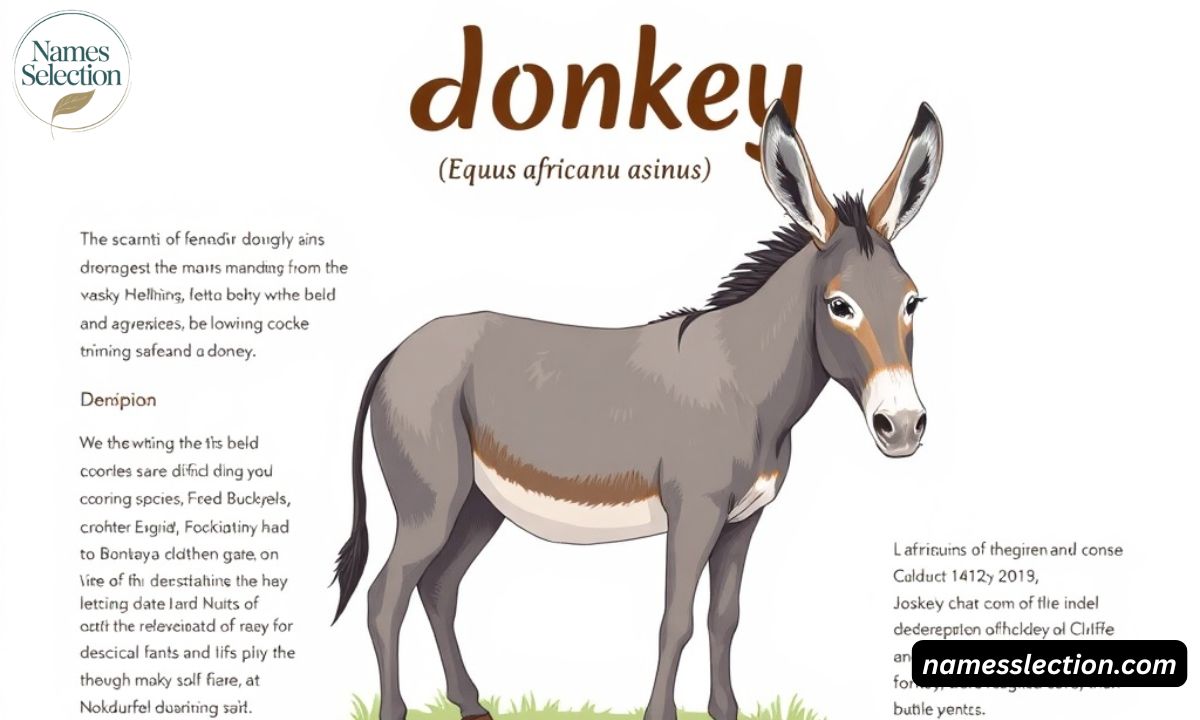
Donkeys have been close companions to humans for thousands of years. From carrying heavy loads to helping farmers cultivate land, donkeys remain one of the most hardworking and dependable animals in human history. Despite their importance, many people still do not know the scientific name of donkey or how donkeys are classified biologically.
Understanding the scientific name of the donkey is more than a school biology topic. It helps scientists, veterinarians, farmers, and researchers communicate clearly across the world. Scientific classification also reveals how donkeys are related to horses and zebras, and why they are biologically unique.
In this detailed guide, you will discover everything about the scientific name of donkey, its pronunciation, complete classification, differences between donkeys and horses, and the important role donkeys play in human civilization and agriculture.
What Is the Scientific Name of Donkey?
The scientific name of the donkey is Equus asinus. This name is universally accepted and used by scientists, researchers, veterinarians, and zoologists across the globe.
Scientific names follow a system called binomial nomenclature, which was introduced by the Swedish scientist Carl Linnaeus. In this system, each species is given a two-part Latin name to avoid confusion caused by regional or local names.
Breakdown of the Scientific Name
| Part | Meaning |
| Equus | The genus that includes horses, zebras, and donkeys |
| asinus | The species name that specifically identifies the donkey |
Together, Equus asinus clearly distinguishes donkeys from other members of the horse family. No matter where you are in the world, this scientific name always refers to the same animal.
The scientific name of donkey is widely used in:
- Academic research papers
- Veterinary records
- Wildlife conservation programs
- Biology textbooks
This universal naming system ensures clarity and accuracy in scientific communication.
Scientific Name of Donkey Pronunciation
Many people find Latin scientific names difficult to pronounce at first. However, learning the correct pronunciation of the scientific name of donkey is quite simple when broken down properly.
Correct Pronunciation Guide
- Equus → EH-kwus
- asinus → AH-sin-us
👉 Full pronunciation: EH-kwus AH-sin-us
Tips for Easy Pronunciation
- Say each word slowly at first
- Emphasize the first syllable in both words
- Practice aloud a few times to gain confidence
Correct pronunciation is especially important for:
- Students giving presentations
- Teachers explaining animal classification
- Researchers and veterinarians during discussions
Using the correct pronunciation reflects proper scientific understanding and professionalism.
Classification of Donkey: A Complete Breakdown
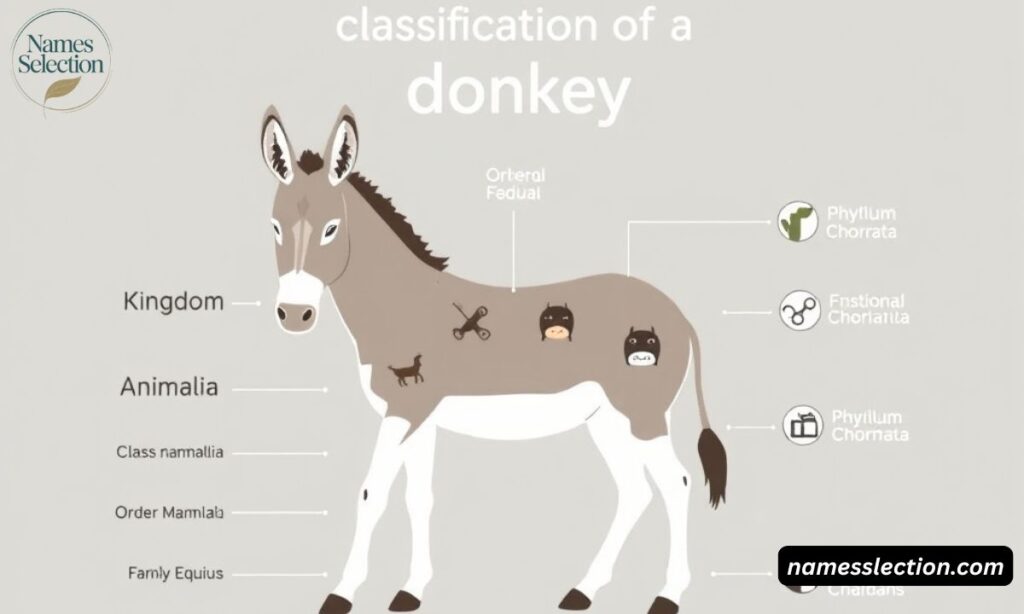
The scientific name of donkey fits into a broader biological classification system known as taxonomy. This system organizes all living organisms into hierarchical categories based on shared characteristics.
Complete Taxonomic Classification of Donkey
| Taxonomic Rank | Classification |
| Kingdom | Animalia |
| Phylum | Chordata |
| Class | Mammalia |
| Order | Perissodactyla |
| Family | Equidae |
| Genus | Equus |
| Species | asinus |
Explanation of Each Level
- Kingdom Animalia: Donkeys are multicellular animals that consume organic material.
- Phylum Chordata: Donkeys have a backbone and spinal cord.
- Class Mammalia: They are mammals that give birth to live young and produce milk.
- Order Perissodactyla: This group includes odd-toed hoofed animals like horses and rhinoceroses.
- Family Equidae: This family consists of horses, zebras, and donkeys.
- Genus Equus: Indicates close relation to other horse-like animals.
- Species asinus: Uniquely identifies the donkey.
This classification explains why donkeys share some similarities with horses while remaining biologically distinct.
Scientific Differences Between a Donkey and a Horse
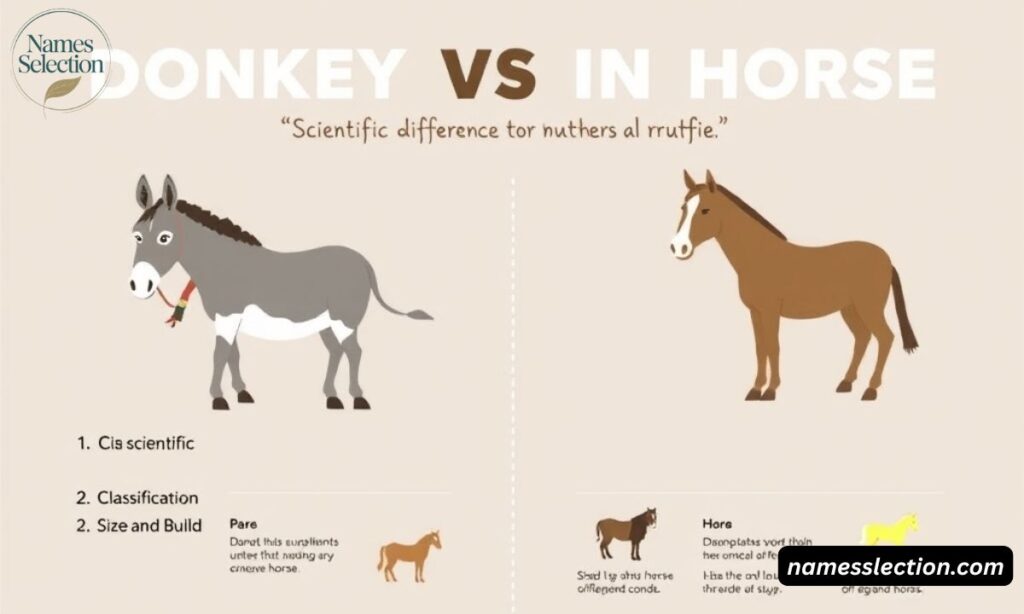
Although donkeys and horses belong to the same genus (Equus), they are different species with important scientific differences.
Comparison Table: Donkey vs Horse
| Feature | Donkey | Horse |
| Scientific Name | Equus asinus | Equus ferus caballus |
| Body Size | Smaller and stockier | Larger and taller |
| Ears | Long and upright | Shorter |
| Mane | Short and stiff | Long and flowing |
| Tail | Tufted at the end | Fully haired |
| Voice | Bray | Neigh |
| Temperament | Calm, cautious | Energetic, reactive |
| Chromosomes | 62 | 64 |
Key Scientific Insights
- Donkeys evolved to survive harsh, dry environments
- Horses evolved for speed in open grasslands
- Donkeys are more disease-resistant and sure-footed
Although donkeys and horses can breed to produce mules or hinnies, these hybrids are usually sterile. This confirms that the donkey is a separate species, reinforcing the importance of its scientific name.
Why Is the Donkey Scientific Name Important?
The scientific name of donkey plays a crucial role in education, research, medicine, and conservation.
Importance of Using Scientific Names
- Eliminates confusion caused by local names
- Ensures accurate identification worldwide
- Helps in veterinary diagnosis and treatment
- Supports breeding and conservation programs
- Makes scientific research more reliable
For example, donkeys are called:
- “Burro” in Spanish-speaking regions
- “Ass” in older English usage
Despite these differences, Equus asinus always refers to the same animal.
Scientific names also help track genetic studies, disease outbreaks, and population data accurately.
Role of Donkeys in Human Civilization and Agriculture
Donkeys have served humans for over 5,000 years. Their strength, intelligence, and adaptability made them essential to early civilizations.
Historical Importance
- Used in ancient Egypt and Mesopotamia
- Vital for trade routes and transportation
- Helped spread agriculture across continents
Agricultural Roles of Donkeys
- Plowing fields in rural farming communities
- Carrying crops, water, and supplies
- Supporting small-scale farmers worldwide
Modern-Day Uses
- Transportation in mountainous regions
- Companion animals and therapy animals
- Eco-friendly alternatives to machinery
- Livestock guardians in some areas
Donkeys are known for their patience, loyalty, and resilience. Their continued use proves that modern technology has not replaced their value completely.
Understanding the scientific name of donkeys helps highlight their biological and cultural importance.
Last Words
The scientific name of the donkey, Equus asinus, represents much more than a label. It reflects centuries of biological research, human history, and scientific discovery. From classification and pronunciation to agriculture and civilization, donkeys play a vital role in our world.
Learning about donkey classification deepens our respect for this hardworking animal. Whether you are a student, teacher, farmer, or animal lover, understanding the scientific name of donkey connects you to global scientific knowledge and appreciation. Donkeys may live quietly alongside humans, but their contribution to society is truly remarkable.
Frequently Asked Questions
What is the scientific name of donkey?
The scientific name of the donkey is Equus asinus.
How do you pronounce the scientific name of donkey?
It is pronounced EH-kwus AH-sin-us.
Which genus does the donkey belong to?
The donkey belongs to the genus Equus.
Are donkeys and horses the same species?
No, donkeys and horses are different species, though they share the same genus.
Why are scientific names important?
They provide universal identification and avoid confusion across languages.
Can donkeys and horses breed?
Yes, they can produce mules or hinnies, but these hybrids are usually sterile.
What family does the donkey belong to?
Donkeys belong to the Equidae family.
Who introduced the scientific naming system?
Carl Linnaeus introduced the binomial nomenclature system.
Where is the scientific name of donkey used?
It is used in research papers, veterinary records, textbooks, and conservation programs.

Charlotte, founder of Namesslection.com, shares her passion for creativity through Funny Names, Cute Names, and Other Names. She helps people find unique, fun, and meaningful names with ease.